
“Religious liberty is not guaranteed for every
generation. It must be reaffirmed, or it will be lost.”
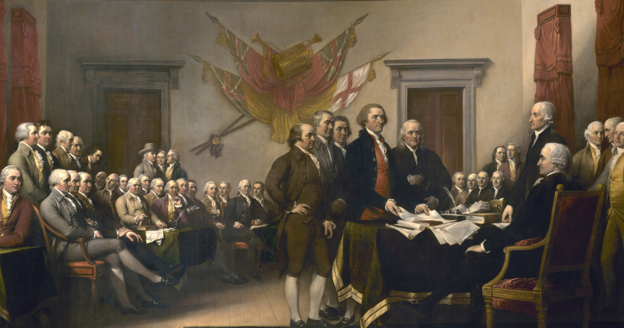
As our nation marks 250 years since the signing of the
Declaration of Independence, it’s worth pausing to reflect on one of the
defining features of the American experiment: religious freedom. We often take
this freedom for granted, but its story is long, winding, and hard‑won. Religious
liberty is one of America’s greatest gifts, and one of its most fragile. And
its future depends on whether each generation chooses to preserve it.
A
Biblical Foundation for Liberty
“… If you confess with your mouth that Jesus is Lord and
believe in your heart that God raised him from the dead, you will be saved. 10 For
with the heart one believes and is justified, and with the mouth one confesses
and is saved.” Romans 10:9-10
Romans 10:9–10 may seem like an unusual place to begin a
discussion on religious liberty, but it captures something essential: true
faith is personal. Genuine faith cannot be coerced from outside influences. Salvation
is a personal choice between each individual and God. True belief arises from
conscience, not compulsion.
This theological truth has profound implications for civil
society. Without governmental or religious coercion, each person is provided
the space for true belief, a belief that comes from the conscience.
A Nation
Born in Religious Diversity
Religion, especially Christianity, played a central role in
America’s founding story. From Puritans in Massachusetts Bay to Anglicans in
Jamestown, Quakers in Pennsylvania, and Baptists in Rhode Island, the New World
became a refuge for those who did not fit neatly into the Church of England.
Historian Daniel Dreisbach notes that at the time of the
Declaration of Independence, 98% of the population was Protestant, and three‑quarters
of them were in the Reformed tradition.[1] Yet this diversity was fragile. Denominational pluralism was a novelty in the
17th and 18th centuries, even if it feels ordinary today.
Still, the seeds of religious freedom were present.
The founders themselves represented a wide range of
religious convictions:
- Patrick
Henry and John Witherspoon were devout.
= George
Washington was reserved in his faith.
- Thomas
Jefferson and Ben Franklin were skeptical of evangelical Christianity.
- Thomas
Paine embraced a combative deism.
Within this diversity we see the genius of the founding
fathers unfold. They understood that when rightly framed this diverse religious
expression would actually be a great strength for our republic
The Long
Road Toward Liberty
In most civilizations, religion and state power were
intertwined. Religion was often used as a tool of the state, and religious
institutions frequently used the state for their own ends. This fusion rarely
allowed freedom for religious dissenters.
America chose a different path.
The Declaration of Independence, though primarily political,
represented a diverse religious coalition seeking freedom from Britain. It was
the beginning step of journey that would see freedom in all areas, including
religious freedom.
Religious liberty did not appear overnight. It developed
slowly and unevenly.
[1]
https://www.pbs.org/godinamerica/interviews/daniel-dreisbach.html
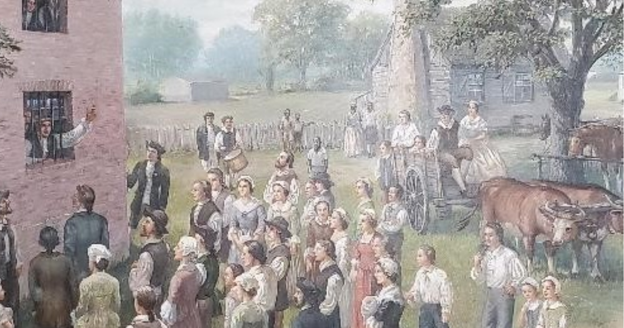
A vivid example comes from Virginia. In the 18th century,
Anglicanism dominated the colony and pushed back against groups like the
Baptists. Baptist preachers were whipped, fined, and even imprisoned for
preaching the Gospel. Their congregations gathered outside the jail to hear
sermons through the window, because the imprisoned pastor could speak even when
the people could not.
Patrick Henry defended these preachers. James Madison and
Thomas Jefferson later played crucial roles in securing religious liberty in
Virginia.
It was in these real lived experiences that the seed of
religious freedom would begin to grow.
The
framing of Religious Freedom
The Constitution of 1787 mentions religion only once: it
prohibits religious tests for federal officeholders. Several states continued
religious tests well into the 19th century.
Religious liberty came with the Bill of Rights in 1791:
“Congress shall make no law respecting an establishment of
religion, or prohibiting the free exercise thereof."
This language was stronger than earlier drafts that affirmed
toleration. Toleration implies permission; liberty implies protection. Madison
understood the difference and strengthened the wording accordingly.
The phrase “separation of church and state” does not appear
in the Bill of Rights. The founders did not use it.
It comes from Thomas Jefferson’s 1802 letter to the Danbury
Baptist Association. The Baptists congratulated Jefferson on his election but
lamented that Connecticut denied them full religious freedom. Jefferson
reassured them that Congress would not interfere with religious expression,
describing a “wall of separation.”
A strong argument can be made that Jefferson was protecting
the church from the government, not excluding religious influence from society.
Jefferson’s metaphor faded from public memory until 1947,
when the Supreme Court resurrected it in Everson v. Board of Education. The
Court ruled that reimbursing bus fare for parochial school students did not
violate the Establishment Clause, but incorporated the clause to the states
through the 14th Amendment.
This dramatically shifted the meaning of “separation of
church and state,” leading courts and politicians to read into the Bill of
Rights what was not there: that religious people should be sidelined in public
life.
I believe that the founders were largely protecting the
church from the government, creating a space where true religious liberty could
thrive.
Modern
errors regarding religious liberty
The experiment in freedom is still on-going. It must be
continually reaffirmed, which means we must deal seriously with challenges to
freedom, especially religious freedom.
Error #1: Sidelining People of Faith
Some argue the founders intended to remove religion from
public life. Others claim all founders were deists. One historian even stated
publicly that in no way was American founded on Christian principles.
But history is more complex. While the founders were not
seeking a theocracy, religious thought was the air they breathed in the late 18th
century. All of them would have been deeply influenced by the King James Bible
(the primary text from which most of them would have learned to read), and it
is estimated that one-third of all the quotes that they used in their writings
came from the Bible.[1] Certainly the principles of freedom would have been born, at least in part,
from their biblical reading.
Even the Declaration of Independence contains theological
underpinnings:
“All men are created equal… endowed by their Creator with
certain unalienable Rights.”
While not explicitly Christian, they are making a profoundly
theological argument that people are created and fashioned by a Creator, from
whom came certain rights.
The founders freely used religious imagery and wording. Rev.
Jacob Duche prayed at the Continental Congress. Franklin, Adams, and Jefferson
proposed biblical imagery, including Moses dividing the Red Sea, for the
national seal.
We should not be embarrassed to use religious language or
symbolism in service to our nation. As people of faith, we can and should use
our voice to be people of influence in the leading of our nation.
Error #2: Fusing Church and State (real Christian
Nationalism)
The phrase “Christian Nationalism” is rarely defined
and is often used as a scare tactic—applied broadly to describe basic
conservative beliefs, especially on issues like abortion or marriage. This
watered‑down use of the term actually obscures the real danger and gives cover
to movements that truly seek to fuse Christianity and politics into a
theocracy.
Real Christian nationalism is something different
entirely. It advocates for a civil government explicitly ruled by Scripture,
with the state enforcing religious doctrine as law. This is far from the
founders’ vision. Historically, Christian theocracies have led to oppression,
particularly of religious minorities, and have damaged both church and state.
For many who drift toward this ideology, the motivation may
begin sincerely. They long for a moral society. They fear the rapid decline of
Christian ideals in public life. But fusing church and state is not the answer.
Whenever the state attempts to enforce belief or morality, both institutions
become corrupted.
Vibrant Christianity
needs no help from the state. Coerced morality never produces genuine faith,
and coerced belief never produces lasting transformation. The answer is not
more governmental control; the answer is a free, faithful, and spiritually
alive church. Religious liberty creates the space where the Gospel can
flourish, not through compulsion but through conviction.
The
Gospel and the Republic
We should be thankful for the providence of God in raising
up the founding generation and for the freedoms they secured. Those religious
liberties have provided space for the growth of the church in America and the
spread of the Gospel throughout the world. We do not ignore the nation’s
failures, but we recognize God’s grace in what He has allowed to flourish.
But our ultimate allegiance is not to the state, but to God.
We should steward our freedom to spread the Gospel of Jesus
Christ to our nation and to the nations. The American experiment has provided
unusual space for this mission, but it is not the source of our hope.
“If you confess with your mouth that Jesus is Lord and
believe in your heart that God raised him from the dead, you will be saved.”
This is the hope we proclaim, not the hope of a
nation, but the hope of the Gospel: the risen Christ.
[2]
https://www.cslewisinstitute.org/resources/the-bible-and-the-american-founders